Get to Know the Hawaiian Short Eared-Owl (Pueo)
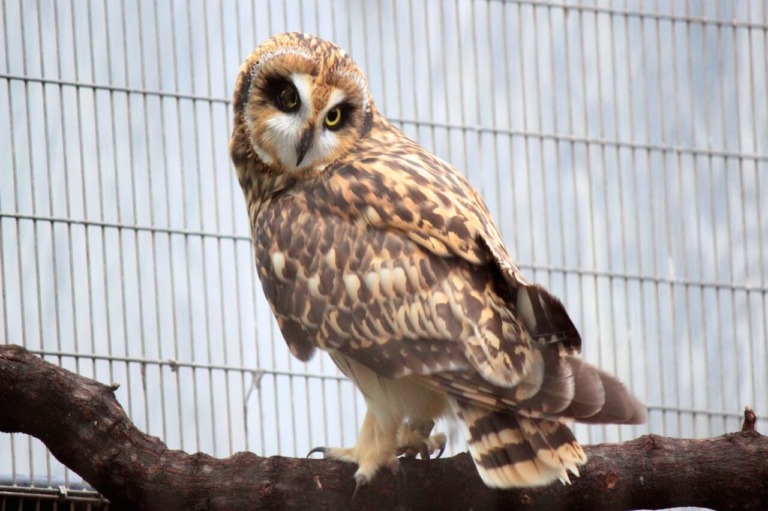
Pueo are easily distinguished from the introduced Barn Owl by their piercing yellow eyes and the mottled brown patterns across their head, wings, back and chest, as well as the white ring that frames their face. Feathers on this species extends down to their talons.
Pueo set themselves apart from other owl species in that they are diurnal and hunt during the day, usually in the mornings and late afternoons.
Males perform aerial dance displays in order attract mates, and the nests are built on the ground.
About
Scientific Name: Asio flammeus sandwichensis
Kingdom: Animalia
Phylum: Chordata
Class: Aves
Order: Strigiformes
Physical Characteristics
Pueo are easily distinguished from the introduced Barn Owl by their piercing yellow eyes and the mottled brown patterns across their head, wings, back and chest, as well as the white ring that frames their face. Feathers on this species extends down to their talons.
Diet
Pueo are primary hunters of introduced mice and rats, and it is believed that it was the arrival of these small mammals through the Polynesians that allowed the Pueo to become established in the Hawaiian Islands.
Distribution
Pueo can be found throughout the 8 main Hawaiian Islands at elevations from sea level to 8,000 feet in a wide variety of habitats. However, they favor grassland shrubland, and even urbanized park areas.
Behavior
Pueo set themselves apart from other owl species in that they are diurnal and hunt during the day, usually in the mornings and late afternoons. Males perform aerial dance displays in order attract mates, and the nests are built on the ground.
Reproduction & Growth
Females have the responsibility of brooding and incubation, and it is up to the males to hunt and defend the nests. Chicks hatch one at a time to avoid extreme competition for food, and will leave the nest at about 2 months of age; sometimes before they even learn how to fly.
Notes On Conservation
Although Short-eared Owls are globally listed as a species of Least Concern, the Hawaiian population of Pueo remains distinct and thus, is considered Endangered by the State of Hawaii. These birds are more resistant to human-caused changes compared to other native species, however, they are still susceptible to attacks from introduced dogs, cats, and mongooses, and are known to be frequent victims of vehicle strikes.
Honolulu Zoo
Makamae came to the Honolulu Zoo from the island of Kauai, where it was discovered that he had a damaged eye and may not survive in the wild. At the zoo, he is being glove-trained by his keepers and is regularly allowed to practice his amazing hunting capabilities on non-living food items.
Citations
Hawaii’s comprehensive wildlife conservation strategy. (2005). Honolulu, HI: Dept. of Land and Natural Resources.