
Get to Know the Dyeing Poison Dart Frog
Scientific Name: Dendrobates tinctorius
Fun Facts:
The regular prey for these amphibians include small, but highly poisonous species of ants, termites, and beetles.
Their bodies are believed to in turn, use these poisons for their own defense, contributing to the frog’s infamous toxicity.
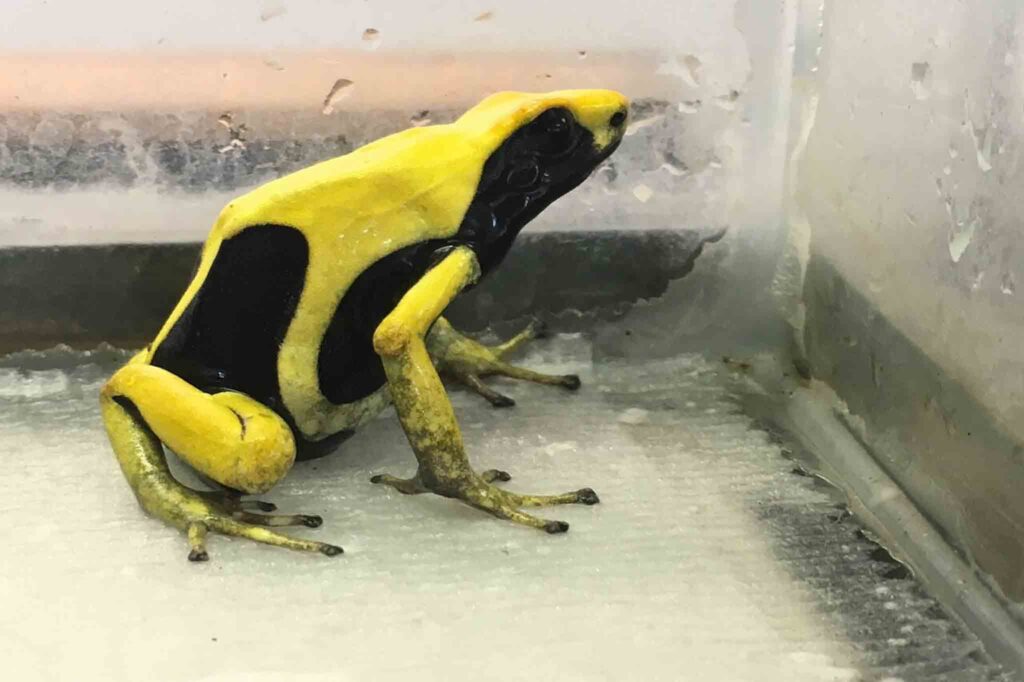
Like most Poison Dart Frogs, these animals only grow to be about two inches. This species of frog comes in a wide variety of colors and patterns. Some individuals are a brilliant sapphire blue with speckled black spots, others can be yellow and blue with large black patches. Others can be a strong black with colorful stripes or spots.
About
- Kingdom: Animalia
- Phylum: Chordata
- Class: Amphibia
- Order: Anura
Physical Characteristics
Like most Poison Dart Frogs, these animals only grow to be about two inches. This species of frog comes in a wide variety of colors and patterns. Some individuals are a brilliant sapphire blue with speckled black spots, others can be yellow and blue with large black patches. Others can be a strong black with colorful stripes or spots.
Diet
The regular prey for these amphibians include small, but highly poisonous species of ants, termites, and beetles. Their bodies are believed to in turn, use these poisons for their own defense, contributing to the frog’s infamous toxicity.
Distribution
The Dyeing Poison Dart Frog is found in lowland forests in the Guianas and in Brazil.
Reproduction & Growth
Like many species in this genus, the female lays her eggs away from the water and the clutch is tended by the male. After the tadpoles are hatched, the father “froggybacks” them to a watersource for them to feed and grow.
Notes on Conservation
This is a species of Least Concern, as they breed readily in captivity, and much of their habitat is inaccessible to humans.
At the Honolulu Zoo
These captive-bred amphibians are on display at the Honolulu Zoo’s Reptile and Amphibian Complex, where their bright colors make them an easily visible favorite to zoo visitors.
Citations
Dendrobates tinctorius . (n.d.). Retrieved January 11, 2017, from http://www.iucnredlist.org/details/55204/0
Poison Dart Frogs. (2017, January 07). Retrieved January 11, 2017, from http://www.nationalgeographic.com/animals/amphibians/group/poison-dart-frogs/