Get to Know the Ornate Horned Frog
Scientific Name: Ceratophrys ornata
Fun Facts:
- Ornate Horned Frogs are diurnal and spend most of their day lying in ambush capable of making powerful forward lunges at nearby prey. Combined with its large gaping mouth, this attribute has also earned it the name of “Pacman Frog”.
- Tadpoles are capable of making a distress call by forcing air out of their developing lungs. This is notable as they are the first and only known example of vertebrate larvae being able to make such calls.
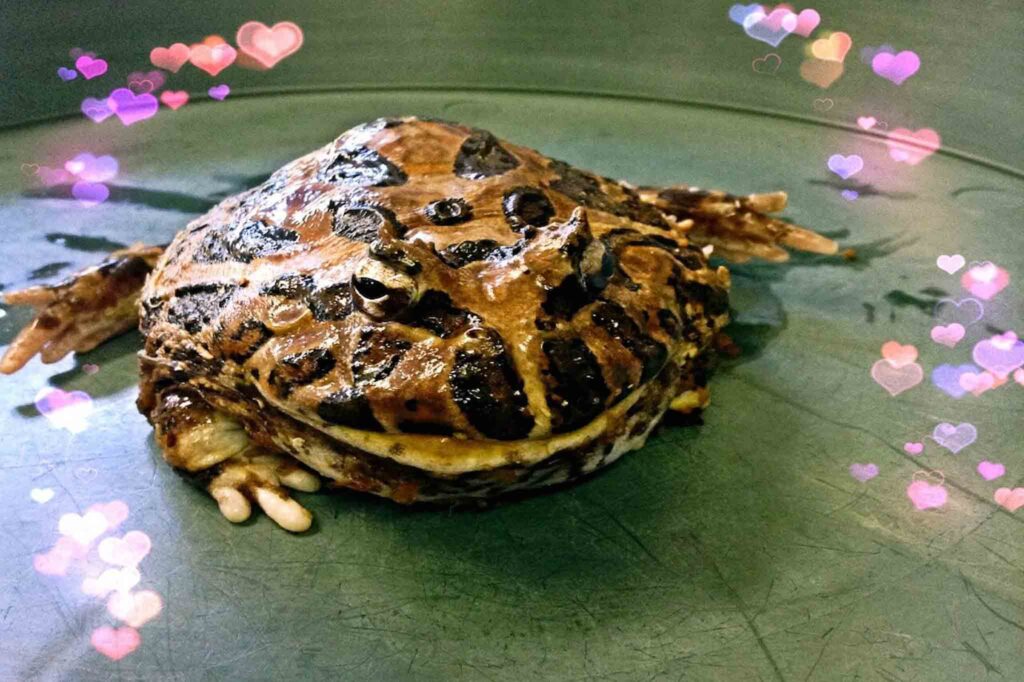
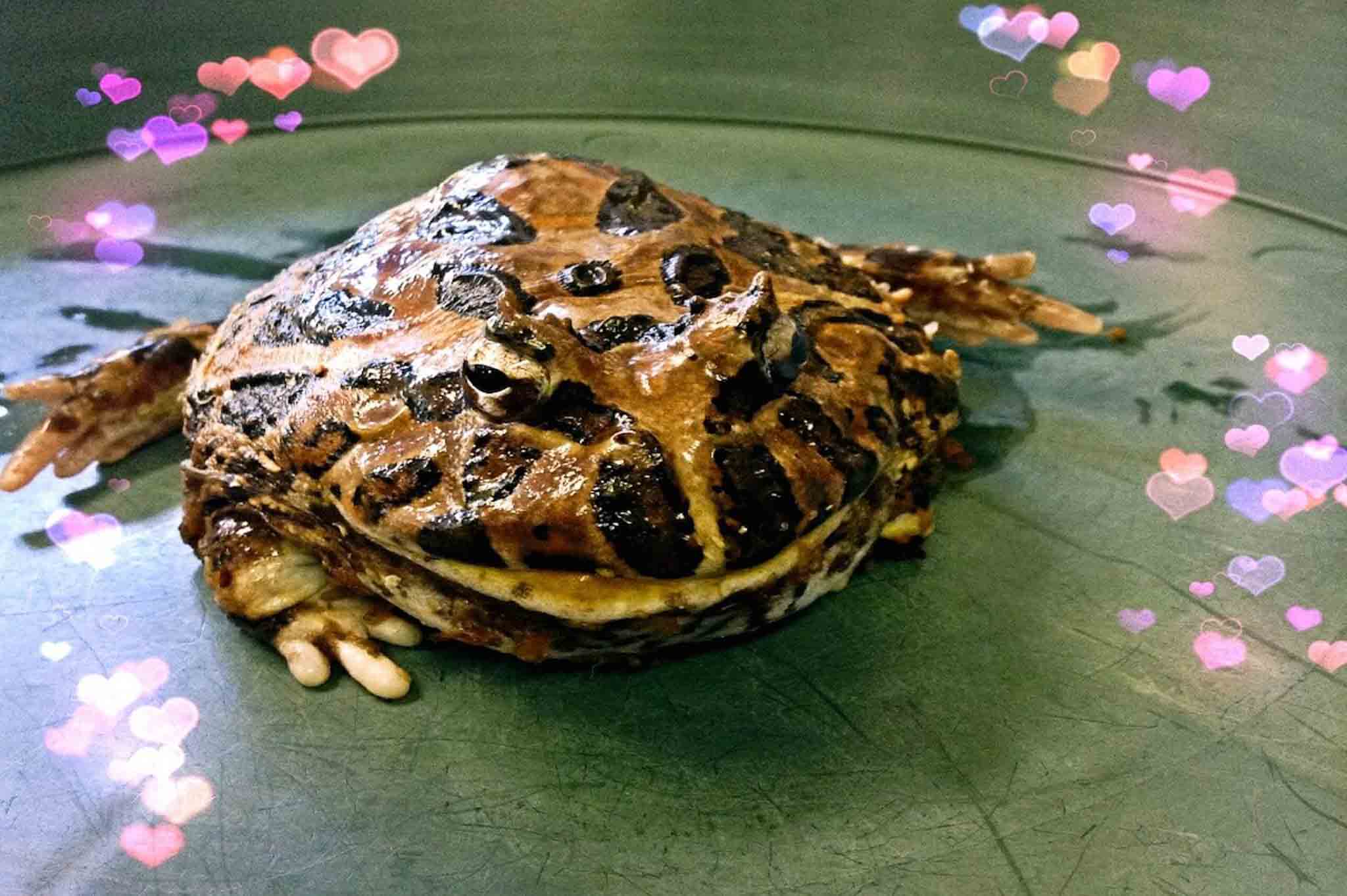
These amphibians have squat, rounded bodies with jaws as wide as their head. Unlike many frog species, its legs are relatively short and it is not a strong jumper. This frog gets its name from the small crests located above their eyes, resembling horns. Males generally grow to be 4.5 inches and females larger, at 6.5 inches in length. These frogs generally have yellow to white-colored undersides, and their backs and limbs are unusually a combination of greens, browns, yellows, and reds.
About
- Kingdom: Animalia
- Phylum: Chordata
- Class: Amphibia
- Order: Anura
Physical Characteristics
These amphibians have squat, rounded bodies with jaws as wide as their head. Unlike many frog species, its legs are relatively short and it is not a strong jumper. This frog gets its name from the small crests located above their eyes, resembling horns. Males generally grow to be 4.5 inches and females larger, at 6.5 inches in length. These frogs generally have yellow to white-colored undersides, and their backs and limbs are unusally a combination of greens, browns, yellows, and reds.
Diet
The Ornate Horned Frog is an extreme carnivore and will take anything it can fit into its mouth, from invertebrates, to small birds and mammals, and even other frogs.
Distribution
This species is native to Argentina, Brazil, and Uruguay, where they are commonly found in grassland near temporary bodies of water, and roadside ditches.
Behavior
Ornate Horned Frogs are diurnal and spend most of their day lying in ambush. Despite it’s short legs, it is capable of making powerful forward lunges at nearby prey. Combined with its large gaping mouth, this attribute has also earned it the name of “Pacman Frog”. Tadpoles are capable of making a distress call by forcing air out of their developing lungs. This is notable as they are the first and only known example of vertebrate larvae being able to make such calls.
Reproduction & Growth
Pools are used for breeding in the late spring, during the rainy season. Because these pools are temporary, the young develop quickly, and begin to develop lungs as early as three days of age.
Notes on Conservation
The Ornate Horned Frog is considered a Near Threatened species. Its population is declining in the wild, with the greatest threats being persecution by humans, collection for the exotic pet trade, and loss of habitat.
At the Honolulu Zoo
The Honolulu Zoo’s Ornate Horned Frog can be found living in the Reptiles and Amphibian complex. These animals are fed a humanely euthanized mouse once a week.
Citations
Ceratophrys ornata . (n.d.). Retrieved January 12, 2017, from http://www.iucnredlist.org/details/56340/0
AmphibiaWeb – Ceratophrys ornata. (n.d.). Retrieved January 12, 2017, from http://amphibiaweb.org/species/5723