
Get to Know the Fiji Banded Iguana
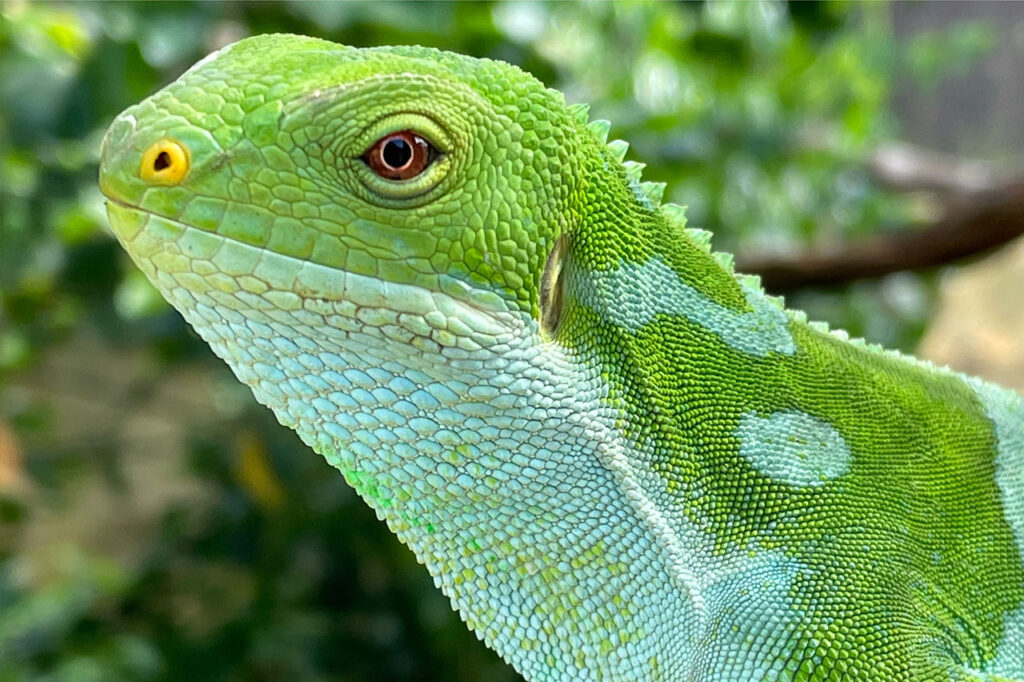
The Fiji Banded Iguana is a vibrant green lizard with blue or light green markings, native to the islands of Fiji.
Primarily arboreal and diurnal, these iguanas feed on leaves, flowers, and fruits while spending most of their time climbing and basking in trees. Females lay eggs on the forest floor, and hatchlings are independent from birth.
As an endangered species, they face threats from habitat loss and invasive species. At the Honolulu Zoo, visitors can observe these striking reptiles in a habitat designed to mimic their natural treetop environment.
Physical Characteristics
Adults can grow up to 21 inches, with most of their length from the tail. Their bright green coloration with blue or light green markings provides natural camouflage in their arboreal habitat.
Diet
Fiji Banded Iguanas are primarily herbivorous, feeding on flowers, fruits, and leaves.
Distribution
This species is found on some of the islands of Fiji. Fiji Banded Iguanas are arboreal, meaning they primarily live in trees.
Reproduction & Growth
Female iguanas descend from the canopy to nest. They dig a hole, lay their eggs, and cover it with dirt and leaf litter before returning to the treetops. Hatchlings are independent and care for themselves from birth.
Behavior
Fiji Banded Iguanas are diurnal, meaning they are active during the day. They spend most of their time climbing in search of food. Being ectotherms, they rely on the environment to regulate their temperature. At the Honolulu Zoo, they can be seen climbing and basking in the top half of their exhibit.
Notes on Conservation
The Fiji Banded Iguana is an endangered species, threatened primarily by human encroachment and invasive species. As an island species, habitat loss leaves them with limited space and resources. Invasive species further threaten their survival.