Get to Know the African Crowned Crane
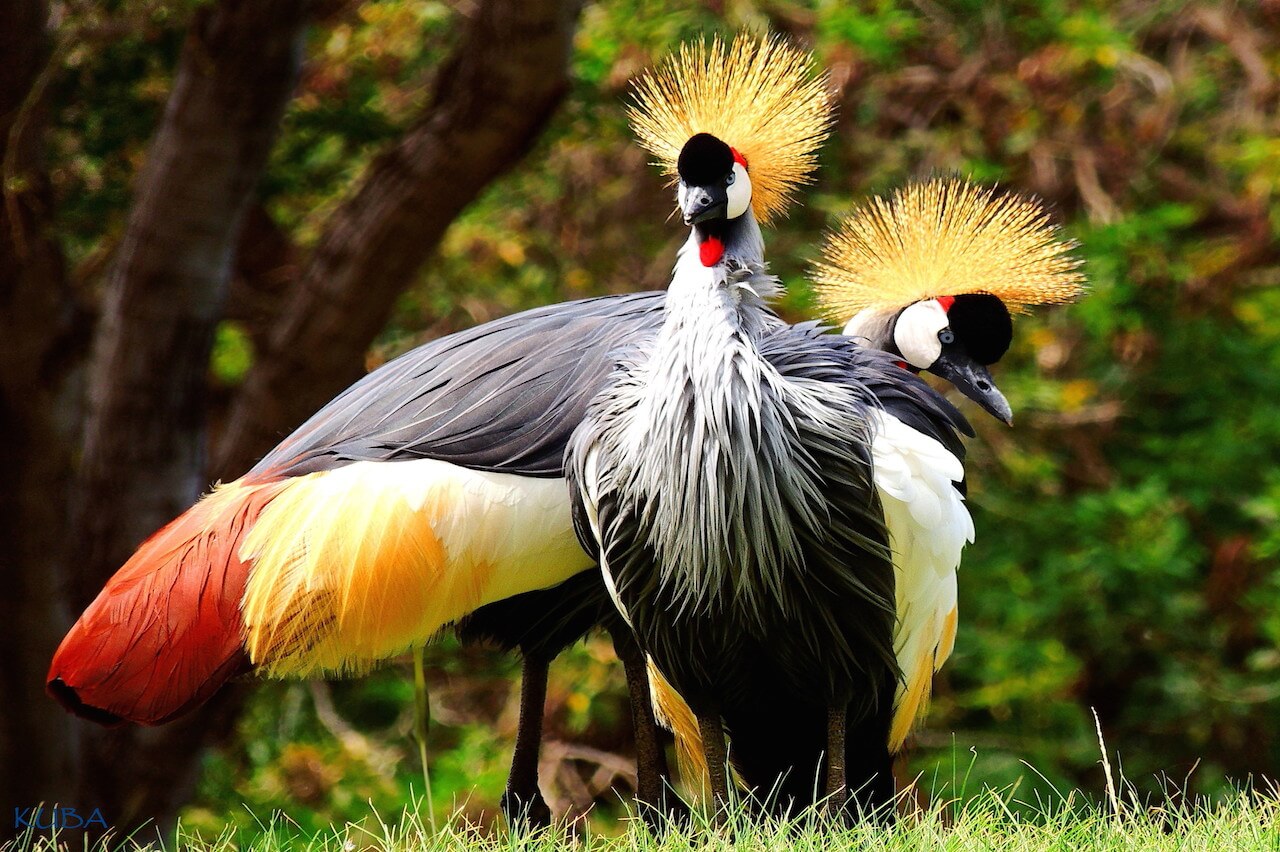
The Crowned Crane Balearica pavonina, stands about 41 inches. It is a majestic bird with a yellow topknot on the crown, black plumage, white and yellow wing-coverts and a black forehead.
There is a red throat-wattle and bare, white or red-white cheeks, with a fairly short bill. Its call is a 2 note honk ‘graa-oww.’ Its range is Kenya and Uganda and southward to Central Africa. It is locally common in marshes and other damp habitats.
About
Kingdom: Animalia
Phylum: Chordata
Class: Aves
Order: Gruiformes
Physical Characteristics
The Crowned crane Balearica pavonina, stands about 41 inches. It is a majestic bird with a yellow topknot on the crown, black plumage, white and yellow wing-coverts and a black forehead. There is a red throat-wattle and bare, white or red-white cheeks, with a fairly short bill. Its call is a 2 note honk ‘graa-oww.’ Its range is Kenya and Uganda and southward to Central Africa. It is locally common in marshes and other damp habitats.
Distribution
Cranes are found throughout the world except in South America, the Malayan Archipelago, the Pacific Islands, and New Zealand. These two cranes are found in Africa.
Behavior
Most cranes are strongly gregarious. They migrate and winter in large flocks. Migrating cranes travel high in the air usually in a V formation. They frequently fly at considerable altitudes, reportedly as high as 2 miles.
The dancing ceremonies of cranes are spectacular. In these, the birds walk stiffly around each other with quick steps, wings half spread. Alternately, they leap high in the air. These antics are frequently interspersed with deep bowings and stretchings. The birds pick up sticks or pieces of grass in their beaks, throw them up in the air, and stab at them with their beaks as they come down.
Both sexes take part in these antics, and immature birds dance almost as often and as actively as the adults do. While the dancing is at times an integral part of courtship, the birds indulge in it throughout the year and some believe it is more an expression of exuberance and liveliness than an inherent sexual display.
Diet
Cranes are mainly vegetarians, eating all sorts of grains, berries, small fruits, and tender roots. They also eat insects and insect larvae, worms, snails, amphibians and reptiles, small birds and mammals, but very few fish.
They drink water by dipping their bill below the surface almost to the nostrils, then raising the head quickly to swallow.
Reproduction & Growth
All cranes are ground nesters, and build fairly bulky nests of vegetation in marshy areas, frequently surrounded by water. The normal clutch is 2 eggs. The eggs are a dull-white to brown and spotted. The Crowned crane’s eggs are a clear, pale blue. Incubation is 28-35 days.
Both parents share the duties of nest building, incubating, and caring for the young. The young hatch covered with red-brown to grayish down and can run actively as soon as they hatch. At 10 weeks of age they can fly.
Cranes are traditionally long-lived birds and among the Japanese are one of the symbols of longevity. The oldest crane for which there is a reliable record is one that lived in captivity 43 years.