
Get to Know the Green and Black Poison Dart Frog
Scientific Name: Dendrobates auratus
Fun Facts:
These frogs are most active after rainstorms, and communicate via buzzing vocalizations.
Males are territorial and during the breeding season, females often compete for access to males.
Poison Dart Frogs are insectivores and in their native habitat, they specialize in eating certain poisonous ant species from which their bodies’ own poison is derived.
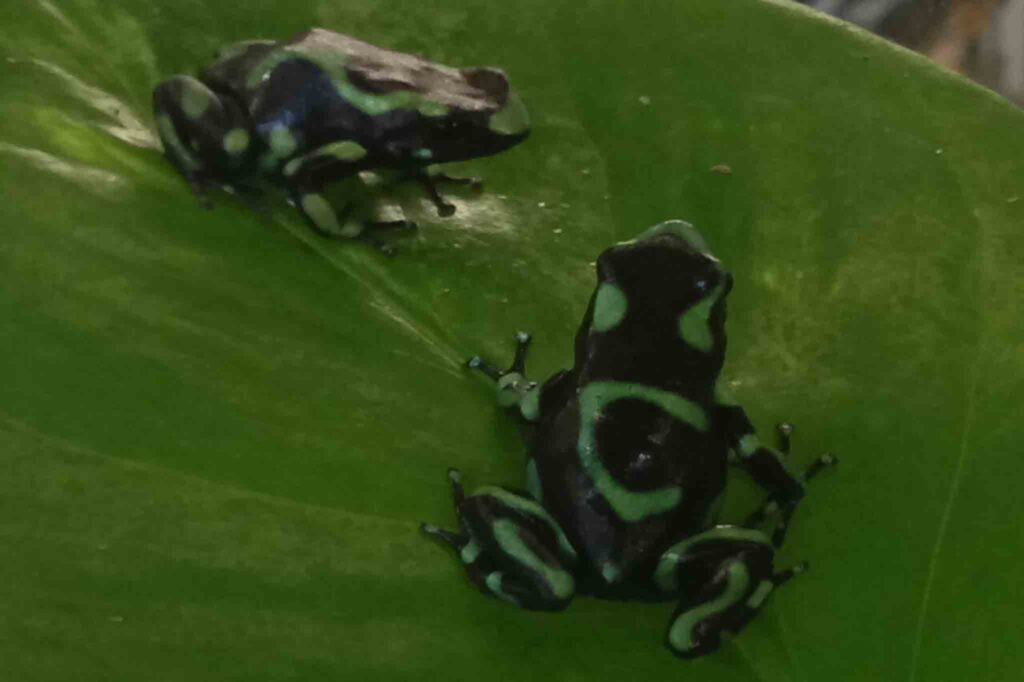
This small frog grows to about two inches long and is immediately recognizable for its brilliant green colors, amplified in intensity by a black background. These aposematic colors serve to warn of how poisonous they are.
About
- Kingdom: Animalia
- Phylum: Chordata
- Class: Amphibia
- Order: Anura
Physical Characteristics
This small frog grows to about two inches long and is immediately recognizeable for its brilliant green colors, amplified in intensity by a black background. These aposomatic colors serve to warn of how poisonous they are.
Diet
Poison Dart Frogs are insectivores and in their native habitat, they specialize in eating certain poisonous ant species from which their bodies’ own poison is derived.
Distribution
This frog is native to the lowland forests of Columbia, Costa Rica, Panama, and Nicaragua. They have been introduced to areas of Hawaii such as Manoa Valley.
Behavior
These frogs are most active after rainstorms, and communicate via buzzing vocalizations. Males are territorial and during the breeding season, females often compete for access to males.
Reproduction & Growth
After mating, the males care for the tadpoles by transporting them to bodies of water for them to grow and develop in. After as long as 43 days, they metamorphosize into juvenile froglets and are able to leave the water.
Notes on Conservation
This is a species of Least Concern as they are widely distributed both in and out of their native range. The IUCN Red List cautions however, that populations could be threatened by over harvesting for the pet trade.
At the Honolulu Zoo
Our green and black poison dart frogs are “local” specimens, found in Manoa valley. Green and black poison dart frogs were introduced by the Territory of Hawaii in 1932 for mosquito control.
Suggested Reading
Green and Black Poison Dart Frog – Dendrobates auratus – IUCN Red List (Species Assessed for Global Conservation) – Overview. (n.d.). Retrieved January 11, 2017, from http://eol.org/pages/330769/hierarchy_entries/24929092/overviewDendrobates auratus . (n.d.). Retrieved January 11, 2017, from http://www.iucnredlist.org/details/55174/0McKeown, S. (1996). A field guide to reptiles and amphibians in the Hawaiian Islands. Los Osos, CA, U.S.A.: Diamond Head Pub