Get to Know the Matamata Turtle
Scientific Name: Batagur baska
Fun Facts:
Tutong are omnivores, feeding on a range of foods, from river plants to clams buried in the mud.
During the breeding season, females are known to migrate upriver in search of the ideal nesting site; often, the place where they themselves were born. This sometimes means journeys of 50 or 60 miles!
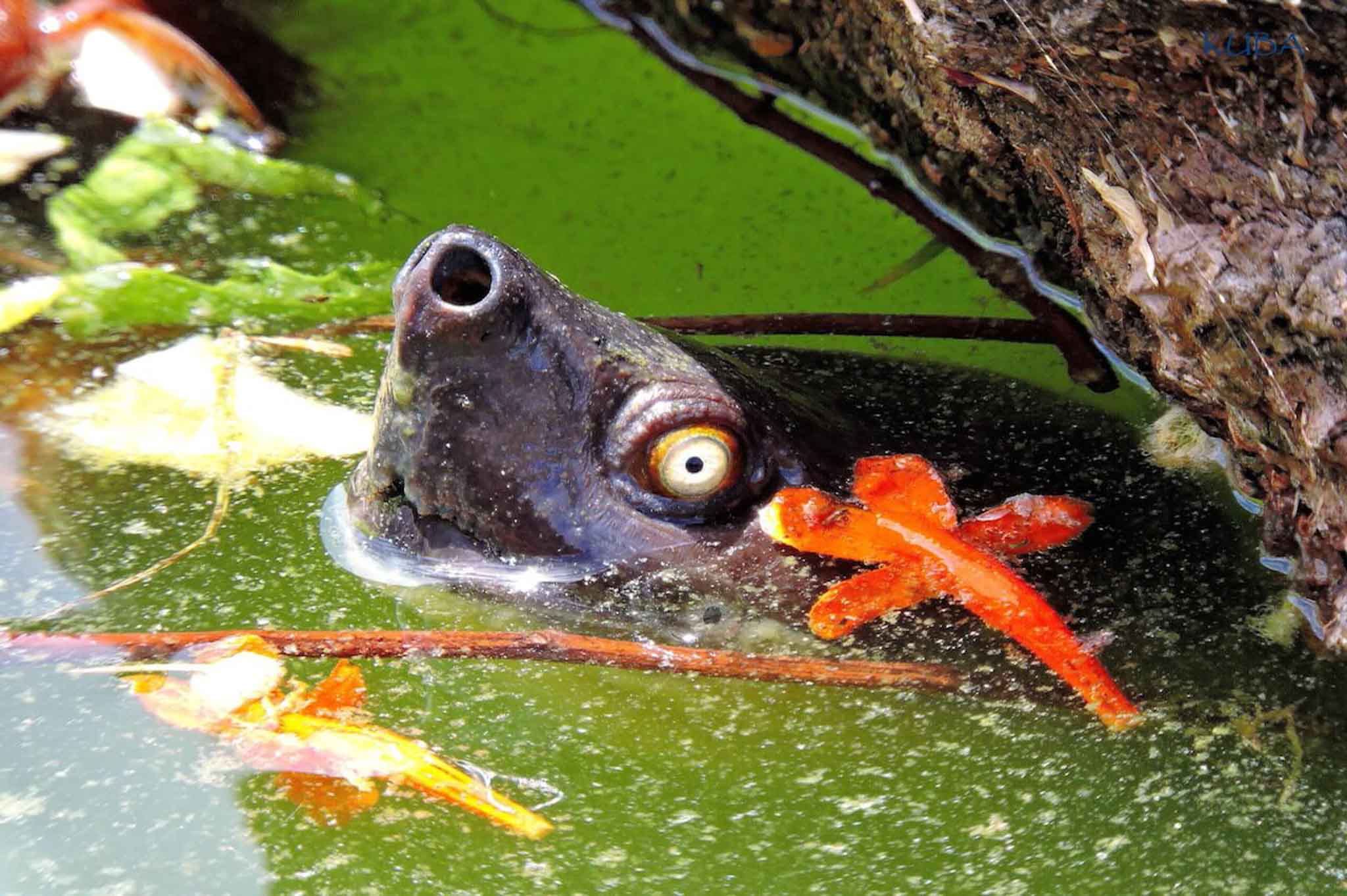
This freshwater turtle can grow to have a shell length of 2 feet! They have easily recognizeable upturned nostrils, and white eyes. Although they are typically olive brown in shell color, the males undergo a remarkable change in the breeding season, sporting black heads, crimson arms and legs, yellow eyes, and an orange ring around the upper portion of their shells!
About
- Kingdom: Animalia
- Phylum: Chordata
- Class: Reptilia
- Order: Testudines
Physical Characteristics
This freshwater turtle can grow to have a shell length of 2 feet! They have easily recognizable upturned nostrils, and white eyes. Although they are typically olive brown in shell color, the males undergo a remarkable change in the breeding season, sporting black heads, crimson arms and legs, yellow eyes, and an orange ring around the upper portion of their shells!
Distribution
The last populations of Tutong are found in India, Indonesia, Bangaladesh, and Malaysia. It is extinct in its former range of Thailand, Myanmar, Vietnam, and Singapore. They are aquatic and spend most of their time in estuaries and creeks.
Behavior
During the breeding season, females are known to migrate upriver in search of the ideal nesting site; often, the place where they themselves were born. This sometimes means journeys of 50 or 60 miles!
Reproduction & Growth
Females can lay 3 clutches of eggs per season, with 13-34 eggs in each clutch.
Diet
Tutong are omnivores, feeding on a range of foods, from river plants to clams buried in the mud.
Notes on Conservation
This animal is Critically Endangered under the IUCN Red List. It is extinct in much of its former range, and the last strongholds for this animal are still poorly protected. It’s primary threats include over-harvest of meat and eggs for food, as well as loss of habitat, boat strikes, and net entanglements.
At the Honolulu Zoo
The Honolulu Zoo is proud to be stewards of this precious species. Our female has sired 14 offspring in 2016.
Citations
Boulenger, George Albert (1890). The fauna of British India, including Ceylon and Burma: reptilia and Batrachia. Taylor & Francis.
Batagur baska Field Guide – Asian Turtle Conservation Network. (n.d.). Retrieved January 12, 2017, from http://www.asianturtlenetwork.org/field_guide/Batagur_baska.htm
Batagur baska . (n.d.). Retrieved January 12, 2017, from http://www.iucnredlist.org/details/2614/0