Get to Know the Hamadryas Baboon
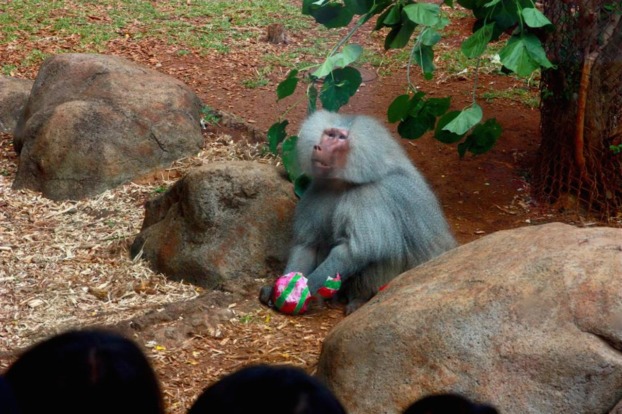
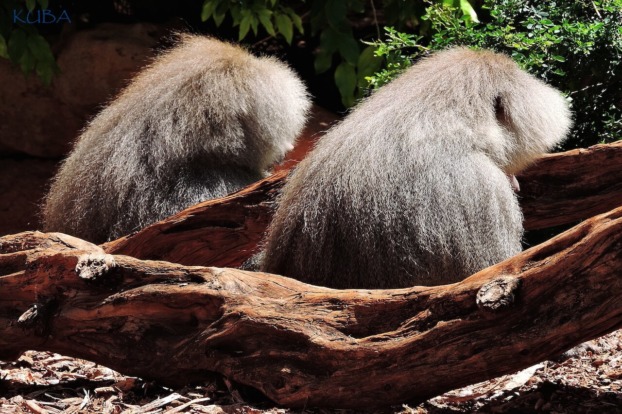
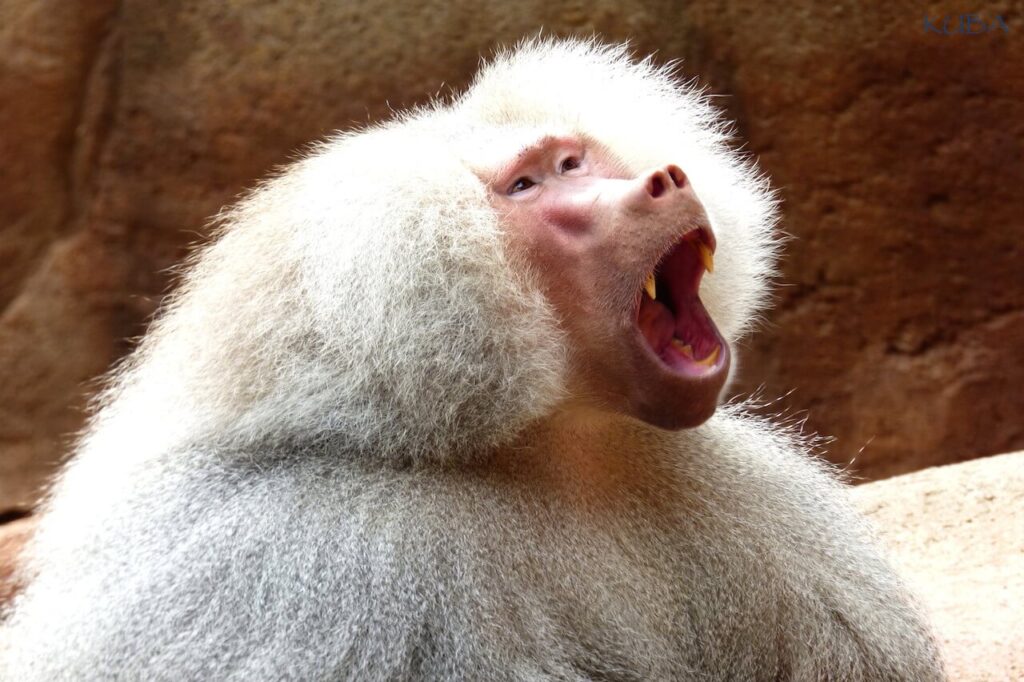
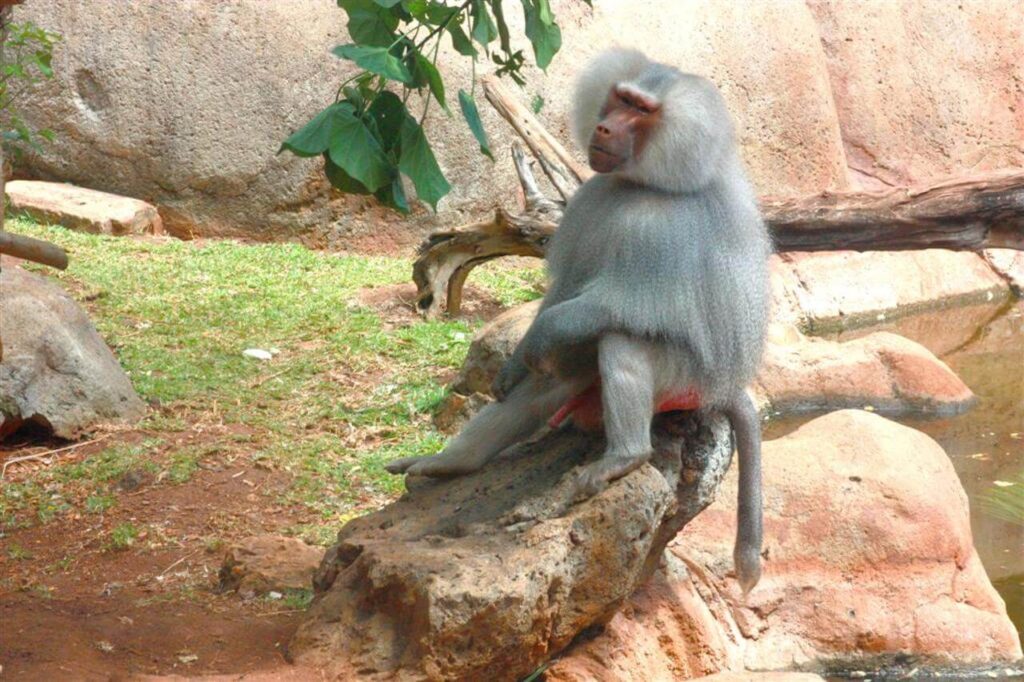
Hamadryas Baboons are easily recognized by the thick silver-gray manes and red faces of the adult males. Females and juveniles lack such distinction. They possess elongated, rectangular muzzles that conceal large fangs several inches in length. Their posteriors possess large, red padding.
Dominant males of each family appear to respect the leadership roles of their fellow dominant males, and regularly coordinate with other family leaders every morning.
Families are comprised of females and their young living under the protection of a single, dominant male, who is also tasked with maintaining the peace among family members.
About
Scientific Name: Papio hamadryas
Kingdom: Animalia
Phylum: Chordata
Class: Mammalia
Order: Primates
Physical Characteristics
Hamadryas Baboons are easily recognized by the thick silver-gray manes and red faces of the adult males. Females and juveniles lack such distinction. They possess elongated, rectangular muzzles that conceal large fangs several inches in length. Their posteriors possess large, red padding.
Distribution
Sacred Baboons are common throughout northeastern Africa, but are extinct in the Nile region and Egypt, where they originally received their name and were worshiped by the ancient Egyptians.
Behavior
Families are comprised of females and their young living under the protection of a single, dominant male, who is also tasked with maintaining the peace among family members. Many families however, often associate with one another to form bands, which in turn further form up to create troops of dozens of baboons. Interestingly, especially among baboons, the dominant males of each family appear to respect the leadership roles of their fellow dominant males, and regularly coordinate with other family leaders every morning. Although males will fight fiercely over unclaimed females, females that are under the protection of rival males are given similar respect and courtesy. Males also tend to form strong kin bonds that extend through adult hood, even after they start their own families, and it is believed that females also maintain a strong kin relationship.
Reproduction & Growth
Dominant males normally monopolize reproductive rights with the females under their stewardship, however female trysts with follower males is not unheard of. These baboons breed throughout the year, and pregnancies last for about 172 days. Puberty occurs in males from 4-7 years old, and 4 years old in females. Females develop much faster than males and reach full size a little over 6 years old. For males, it is more drawn out and can take several years.
Notes on Conservation
Sacred Baboons are considered a species of Least Concern. Despite being extinct in some of their former range, the wild population is actually increasing.
General Information
The male donkey is called jack or jackass.
The female donkey is called the jenny.
A mule is the offspring of a jackass (male donkey) and a mare (female horse).
A hinny is the offspring of a stallion (male horse) and a jenny (female donkey).
At the Honolulu Zoo
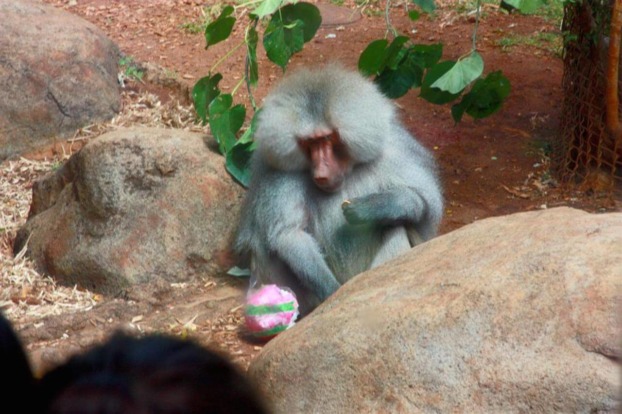
The Honolulu Zoo is home to three males: Clayton, Charles, and Amos. They were born roughly 3 years apart, with Clayton being the oldest in 2000, and Amos the youngest in 2006. Amos is still going through puberty and is noticeably less hairy than Charles and Clayton. As the youngest, Amos tends to be the most playful and loves his toys, however, his actions can become an annoying little brother. Clayton and Charles can be regularly found in front of the main viewing window.
Citations
Shefferly, N. (n.d.). Papio hamadryas (hamadryas baboon). Retrieved January 13, 2017, from http://animaldiversity.org/accounts/Papio_hamadryas/
Papio hamadryas . (n.d.). Retrieved January 13, 2017, from http://www.iucnredlist.org/details/16019/0