Get to Know the Ball Python
Scientific Name: Python regius
Typically, Ball Pythons have white bellies and lightbrown backs, broken by darker brown. They grow to 3-4 feet in length and adult female Ball Pythons are larger than males, possessing longer jaws.
Physical Characteristics
Typically, Ball Pythons have white bellies and lightbrown backs, broken by darker brown. They grow to 3-4 feet in length and adult female Ball Pythons are larger than males, possessing longer jaws.
Diet
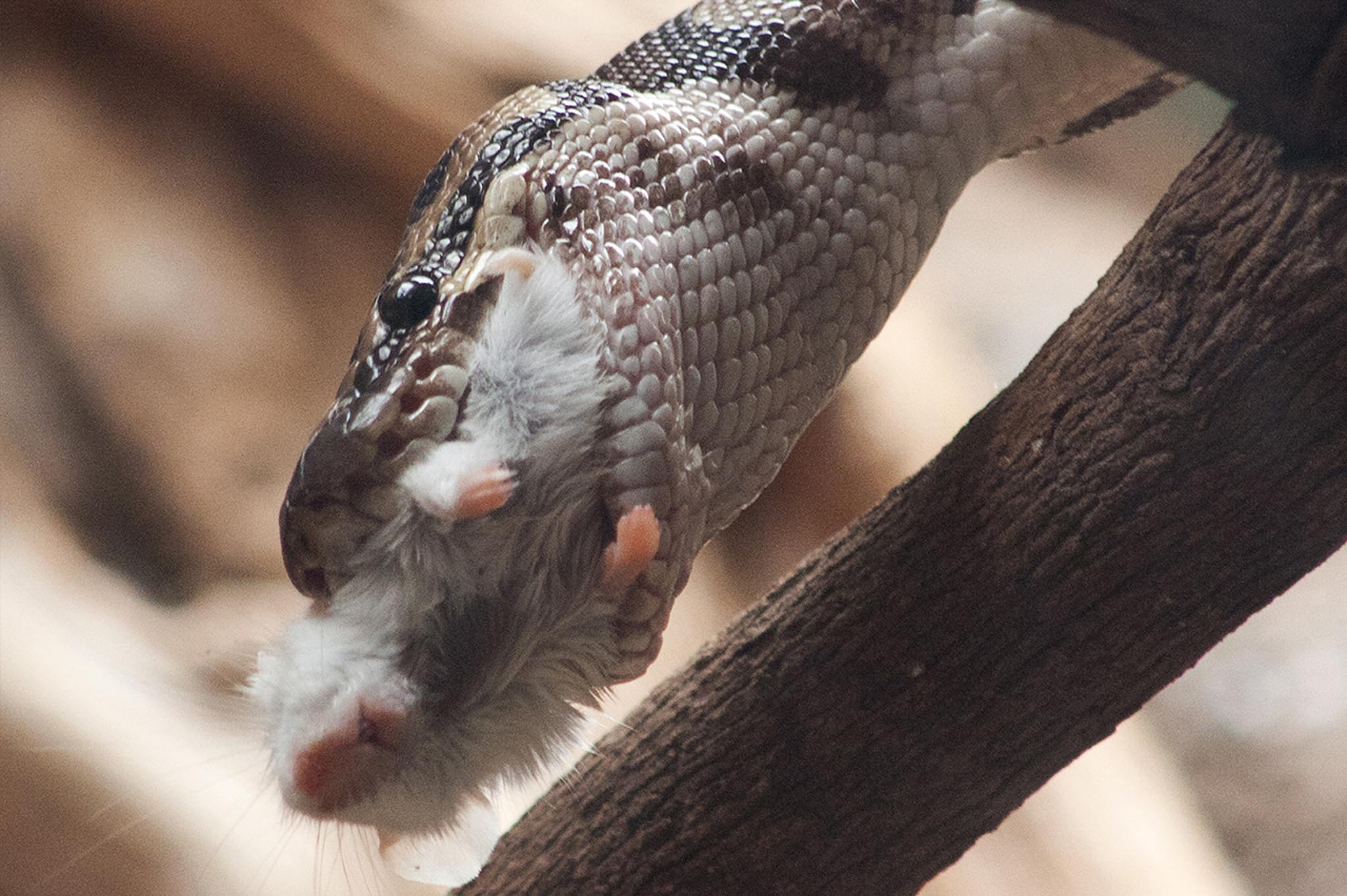
Like all snakes, Ball Pythons are carnivorous and take their prey via constriction—using their coils to cut off blood circulation until the prey looses consciousness. Their primary prey are terrestrial vertebrates; the majority of which are small mammals.
Distribution
Ball Pythons enjoy a wide range, from Senegal across west Africa, through Central Africal, and to Sudan and Uganda.
Reproduction & Growth
Females lay their eggs from mid-February to April, and will use their bodies to incubate their brood for about two months until they hatch. Although the young fend for themselves, they are noted to remain with the vicinity of their mother.
Behavior
Ball Pythons hunt using a variety of senses, including sight, smell, and thermal imaging. Pits along their face allow them to track sources of body heat, while their forked tongues, in connection with a Jacobson’s Organ, allows them to track chemical trails left by prey. It is even believed that Ball Pythons’ vision can tract UV Light reflected by these same trails.
If threatened, they tend to bundle themselves into a protective ball with their head at the center; hence the common name of Ball Python.
Notes on Conservation
Ball Pythons are a species of Least Concern, owing to their wide range distribution. They are hunted as a source of meat and for the pet trade, however, they are also valued as control for rodent pests.
At the Honolulu Zoo
Our male Ball Python, Bounce, was donated to the Zoo by the Department of Agriculture, which found him in one of the amnesty bins at the Hilo Airport. He was left there by a former owner, as exotic reptiles such as snakes are illegal to own in Hawaii.
Citations
http://animaldiversity.org/accounts/Python_regius/
http://www.iucnredlist.org/details/177562/0